Showing posts with label workflow. Show all posts

Perplexity Computer: Agentic AI Redefined

Perplexity Computer: Agentic AI Redefined

Agentic AI has been over-marketed for more than a year. Most products described as agents have remained structured chat systems with tool calls, short execution windows, and limited state continuity. The user still had to supervise most steps, stitch workflows manually, and recover from fragile handoffs. On February 25 and 26, 2026, Perplexity introduced what it called “Perplexity Computer,” framing it as a unified system that can research, design, code, deploy, and manage end-to-end projects across long-running workflows. If those claims hold under real production load, this launch is not an incremental feature release. It is an attempt to redefine what end users and teams should expect from agentic systems.

The right analysis is not marketing-first and not cynicism-first. The right analysis separates what is established from what is inferred and what remains unknown. Established facts from launch coverage and quoted company statements include multi-model orchestration, isolated compute environments with filesystem and browser access, asynchronous execution, and initial availability for Max subscribers under usage-based pricing. Inferred implications include higher workflow compression for technical and operational tasks, lower context-switch overhead, and stronger appeal for teams that value output throughput over model purity. Unknowns include sustained reliability under multi-hour jobs, real-world safety of connector-heavy execution, and whether users can control cost drift when multiple specialized sub-agents run in parallel.

This piece examines those layers directly. It focuses on architecture, product strategy, business model, and operational constraints. It also explains why Perplexity Computer matters beyond Perplexity. The launch reflects a broader shift from “model as product” to “orchestration system as product,” where value is created by coordinating many models, tools, and environments with persistent memory and outcome-oriented execution.

What Is Actually Announced

Multiple reports on February 25 and 26, 2026 quote Perplexity and CEO Aravind Srinivas describing Computer as a unified AI system that orchestrates files, tools, memory, and models into one working environment. The specific claims repeated across sources include support for 19 models, assignment of specialized roles across subtasks, isolated execution environments, and real browser plus filesystem access. Pricing and availability details in those reports indicate rollout to Max users first, usage-based billing, monthly credits, and later expansion to Pro and enterprise cohorts after load validation.

Those statements matter because they define scope. This is not positioned as a single frontier model with extra plugins. It is presented as a control plane for heterogeneous capabilities. The central claim is orchestration depth rather than model exclusivity. That framing is consistent with a practical reality in 2026: no single model is best at everything. Reasoning quality, coding speed, retrieval behavior, tool execution fidelity, cost per token, latency profile, and multimodal quality still vary substantially across vendors and versions. A product that routes work intentionally across that diversity can deliver better aggregate performance than a single-model stack, if routing quality and failure handling are strong.
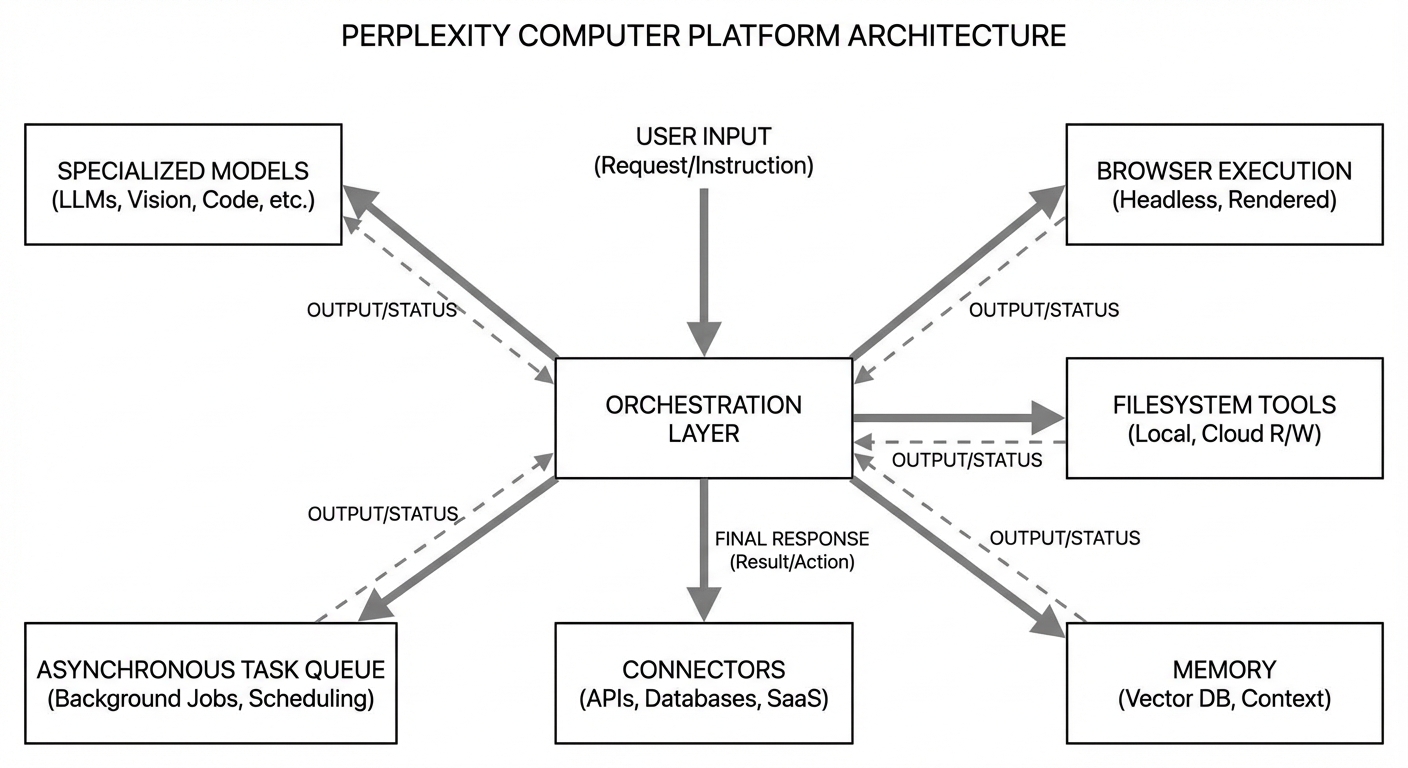
Architecture map showing Perplexity Computer orchestrating models, browser, filesystem, connectors, and memory into long-running agent workflows

Why This Is a Meaningful Shift in Agent Design

The phrase “agentic AI” has become ambiguous. For technical readers, the useful distinction is between interactive agents and execution agents. Interactive agents respond quickly in a conversational loop and may call tools in short bursts. Execution agents decompose goals, run asynchronous subworkflows, maintain continuity, and return integrated outputs after substantial unattended runtime. Perplexity Computer is explicitly positioned in the second category.

This distinction changes product value. Interactive agents improve local productivity for tasks like drafting, summarizing, and quick analysis. Execution agents target workflow ownership. They can absorb project overhead that currently sits between teams and systems: collecting references, generating intermediate artifacts, writing and running code, validating outputs, and iterating until constraints are met. The key metric is no longer response quality per prompt. It is completed work per unit of human attention.

That is where Perplexity’s framing is strategically sharp. If the product can run “for hours or even months” as quoted in launch coverage, the battleground moves from chatbot preference to orchestration reliability and control economics. The buyer question becomes operational: can this system finish meaningful work without requiring constant rescue.

Architecture: Multi-Model Orchestration as the Core Abstraction

In launch reporting, Srinivas emphasizes that Computer is “multi-model by design,” with model specialization treated like tool specialization. This mirrors how mature software systems treat infrastructure. A production stack does not use one database, one queue, one cache, and one runtime for every workload. It composes components based on workload characteristics. Agent systems are now following the same pattern.

From a systems viewpoint, this architecture has clear upside. First, it allows performance routing. High-complexity reasoning can go to models with stronger chain consistency, while deterministic transformations can go to faster and cheaper models. Second, it supports resilience. If one model has degraded performance, routing can shift without collapsing the whole workflow. Third, it supports cost optimization by assigning high-cost models only where their marginal quality is valuable.

The downside is orchestration complexity. Routing logic itself becomes a failure surface. Model interfaces differ, tool-calling behaviors differ, and failure semantics differ. If a workflow spans multiple agents and one sub-agent fails silently or returns malformed intermediate state, downstream steps may produce confident but invalid outputs. This is why the true quality signal will come from longitudinal workload data, not launch demos.

Isolated Compute Environments: Strong Claim, Hard Requirement

A second notable launch claim is isolated environments with real filesystem and browser access. If implemented with strong isolation boundaries, this addresses a major weakness in first-generation agents: weak execution realism. Many earlier systems could suggest code but could not reliably operate in an environment that resembled real project conditions. Real browser and filesystem access can close that gap.

Yet this also raises the security bar. Agent environments with broad connectors and execution permissions need rigorous controls around credential scope, outbound actions, data retention, audit trails, and rollback. Without robust policy layers, a capable agent can also be an efficient failure amplifier. Enterprises will evaluate this through governance controls, not only task completion rates.

This is where Perplexity’s enterprise trajectory matters. Comet enterprise materials emphasize secure deployment and organizational controls in browser contexts. If Computer inherits and extends those control primitives into agent workflows, the enterprise case strengthens. If controls are shallow relative to autonomy depth, adoption will be limited to low-risk and experimental workloads.

Business Model: Usage-Based Pricing Is Rational, but User Risk Moves Upstream

Perplexity’s launch framing around usage-based pricing is economically coherent for orchestration products. Multi-agent runs consume variable resources depending on task complexity, model selection, and runtime duration. A flat fee can hide cost until margins collapse, or enforce strict caps that cripple usefulness. Usage pricing aligns spend with work volume.

The practical issue is budget predictability. For end users and teams, orchestration depth can convert into cost volatility if tasks spawn many sub-agents or rerun loops after partial failures. Credit systems and spending caps help, but they are not enough by themselves. Serious users will need workload-level observability: per-run token cost, model mix, connector call volume, failure retries, and final output utility. Without this transparency, users cannot optimize behavior and procurement cannot govern spend effectively.

This is a structural trend across agent products in 2026. Capability marketing focuses on what agents can do. Operational adoption depends on whether teams can forecast and control what agents cost.

How Perplexity Computer Compares to the Current Agent Field

A direct benchmark is difficult because vendors publish uneven metrics and define “agent” differently. Still, the market can be segmented in a useful way. There are browser-embedded assistants, coding agents tied to repositories and CI, workflow automation platforms connected to SaaS ecosystems, and general-purpose orchestration systems that attempt to span all of the above. Perplexity Computer is targeting the fourth category.

The closest strategic comparison is not a single model release. It is any system that combines model routing, memory continuity, execution environments, and connectors into a goal-driven control plane. In this segment, differentiation will be decided by five factors: task decomposition quality, long-run reliability, security controls, cost governance, and integration breadth. Model quality still matters, but orchestration quality determines whether capability translates into delivered work.

Perplexity enters this race with two advantages. It already has strong user familiarity around research workflows and citation-oriented answer patterns. It also has clear product momentum around distribution layers such as Comet. The risk is that broad orchestration products can become operationally heavy quickly. They must maintain quality across many domains, not one narrow domain where optimization is easier.

Where the Launch Is Strong

The strongest element is architectural honesty. The company does not pretend one model solves all tasks. It acknowledges specialization and builds around orchestration. This is aligned with how advanced users already work manually, switching tools and models depending on the job. If the platform makes that switching automatic while preserving control, it solves a real friction point.

The second strong element is asynchronous orientation. Most productivity gain from agents will come from reducing synchronous supervision. A system that can run substantial work while a user is offline has materially different economic value than a system that requires constant prompting.

The third strong element is environment realism. Real browser and filesystem access support full-workflow execution rather than synthetic demos. If reliability holds, this can shift agent use from experimentation to production operations.

Where the Launch Is Exposed

The first exposure is reliability at duration. The longer a workflow runs, the more failure points accumulate. State drift, stale assumptions, connector timeouts, partial writes, and tool nondeterminism compound over time. Launch narratives emphasize multi-hour and multi-day execution, which increases scrutiny on durability metrics that are usually not visible in marketing materials.

The second exposure is safety and governance. Execution agents with broad permissions can create real-world side effects. This demands strict permissioning, explicit confirmation boundaries for sensitive actions, forensic logs, and policy constraints that are understandable by non-specialist operators.

The third exposure is user trust under cost uncertainty. Multi-model orchestration can produce excellent outcomes and unexpected bills at the same time. If users cannot predict spend by workload class, adoption will plateau outside high-value use cases.
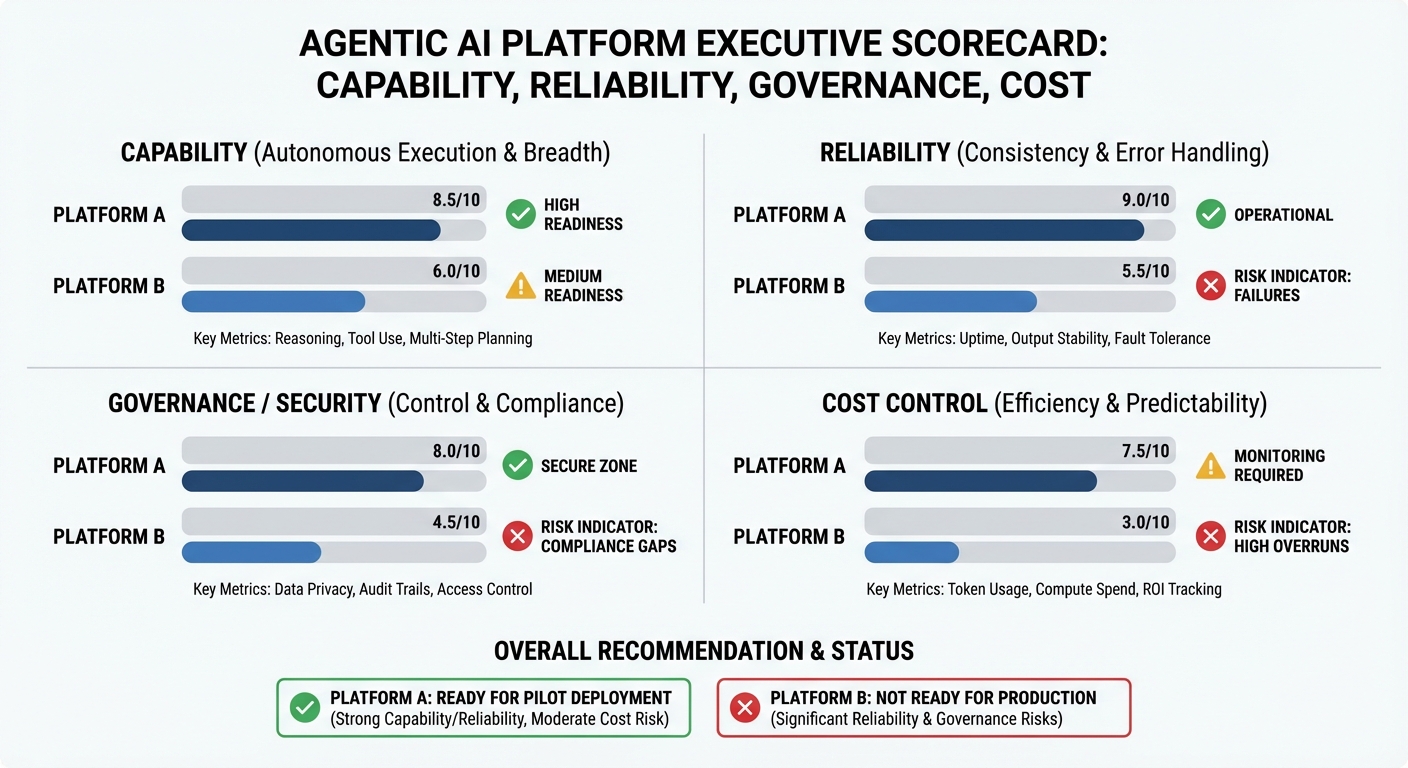
Operational scorecard visual for agentic systems comparing capability, reliability, security governance, and cost control

Evaluation Framework for Teams Adopting Computer

Teams evaluating Perplexity Computer should avoid binary judgments based on launch hype or skepticism. The correct approach is controlled workload testing. Start with three workload classes: bounded research tasks, deterministic build tasks, and mixed tasks with external connectors. Measure completion rate, correction burden, runtime variance, and total cost per completed outcome. Track failure modes in a structured taxonomy: decomposition errors, tool invocation errors, state propagation errors, and policy boundary violations.

Adoption should be phased by risk. Early deployment belongs in reversible workflows with low external side effects. High-impact actions such as production infrastructure changes, billing operations, or legal-communication outputs should stay behind stricter human checkpoints until reliability and governance data are mature.

From a procurement perspective, contract and platform discussions should include explicit controls: max spend per run, configurable model allowlists, retention and deletion controls, exportable logs, and environment-level isolation guarantees. This is not optional detail. It determines whether autonomous execution is governable at scale.

What This Means for the Next Phase of Agentic AI

Perplexity Computer reflects a market transition that now appears durable. The center of gravity is moving from assistant UX to execution systems. Competition is moving from “which model answers better” toward “which orchestration layer completes more work safely at predictable cost.” This favors product organizations that can combine model abstraction, systems engineering, and enterprise control surfaces in one coherent platform.

For users, this transition changes skill requirements. Prompt crafting remains useful, but orchestration literacy becomes more valuable: defining good outcomes, setting constraints, structuring evaluation loops, and diagnosing workflow failures. The operator of the next generation of agentic systems is less a prompt author and more a workflow architect.

For incumbents, the implication is direct. If orchestration becomes the primary product, model providers without strong control planes risk commoditization at the interface layer. For orchestration-first companies, the risk runs the other direction: if underlying model providers vertically integrate and close capability gaps, orchestration margins can compress. This strategic tension will define the next 12 to 24 months.

Twelve-Month Outlook: Realistic Scenarios

Base case: Computer becomes a high-leverage tool for technical users and power operators on specific workflow classes, with measured expansion to Pro and enterprise after reliability tuning. Adoption grows where asynchronous execution and multi-model routing provide obvious ROI.

Upside case: Perplexity demonstrates strong reliability at long runtime, introduces enterprise-grade governance controls quickly, and becomes a default orchestration layer for cross-domain knowledge work. In this case, the product redefines expectations for what “agentic” should mean in commercial software.

Downside case: Reliability variance, opaque cost behavior, or security-control gaps limit trust for mission-critical workflows. Product remains impressive for demos and selective use, but does not cross into broad operational dependency.

Current evidence supports base-case optimism with significant unresolved operational questions. That is a strong launch position, but not a solved execution story.

Key Takeaways

  • Perplexity Computer is positioned as an orchestration system, not a single-model assistant.
  • Launch claims emphasize 19-model routing, isolated execution environments, real browser and filesystem access, and asynchronous long-running workflows.
  • The strategic shift is from response quality per prompt to completed outcomes per unit of human attention.
  • Main strengths are architectural realism, asynchronous execution model, and multi-model flexibility.
  • Main risks are long-run reliability, governance depth, and spend predictability under usage-based pricing.
  • The next phase of agentic competition will be decided by orchestration quality, control surfaces, and cost governance rather than model branding alone.

Sources

Keywords

Perplexity, Computer, agentic, AI, orchestration, models, workflow, automation, browser, enterprise, pricing, reliability

Stay Connected

Follow us on @leolexicon on X

Join our TikTok community: @lexiconlabs

Watch on YouTube: @LexiconLabs

Learn More About Lexicon Labs and sign up for the Lexicon Labs Newsletter to receive updates on book releases, promotions, and giveaways.

Seedance 2.0: Hollywood on Your Desktop

Seedance 2.0: Hollywood on Your Desktop

A new class of AI video tools is turning “film production” into something that looks suspiciously like “typing.” Seedance 2.0 is one of the clearest signals that the center of gravity is moving from sets and crews to prompts and references.

Related Content

Explore Lexicon Labs Books

Discover current releases, posters, and learning resources at http://lexiconlabs.store.

Conversion Picks

If this AI topic is useful, continue here:

Picture a familiar scene. A director leans over a monitor. A cinematographer debates lens choice. A producer watches the clock like it is a predator. The crew waits. The budget burns. Someone asks for “one more take,” and the universe replies with a lighting continuity error and a fresh invoice.

Now picture a different scene. A solo creator sits at a desktop. No camera. No actors. No rented location. No permits. The “shoot” is a folder of reference images, a short audio clip, and a paragraph of text. The output is a cinematic sequence you can iterate in minutes, then stitch into a short film, an ad, a pitch trailer, or a previsualization reel.

That shift is the story. Not “AI can make videos.” That has been true for a while, in the same way it has been true that you can build a house out of toothpicks. The story is that a toolset is emerging that begins to understand film language: multi-shot continuity, consistent characters, controlled motion, intentional camera behavior, and audio that does not feel like an afterthought. Seedance 2.0 is being discussed in exactly those terms, including claims that it supports multimodal inputs (text, images, video, audio) to help creators direct outputs with reference-driven control. (Higgsfield, n.d.; WaveSpeed AI, 2026).

If you have been waiting for the moment when “Hollywood quality” becomes less about Hollywood and more about a workflow, this is one of the moments that should make you sit upright.

What Seedance 2.0 Is, In Plain Terms

Seedance 2.0 is presented as an AI video generation system built to accept multiple kinds of inputs and use them as constraints. It is marketed as multimodal: you can provide text prompts, images, short video clips, and audio references, then guide the generation with a “reference anything” philosophy. The pitch is not subtle: direct AI video like a filmmaker, with consistent characters and production-ready clips. (Higgsfield, n.d.; Seedance2.ai, n.d.).

Third-party writeups framing Seedance 2.0 as a significant step in AI video have emphasized the same themes: improved realism, stronger continuity, and a more “cinematic” feel compared with earlier generations of short, unstable clips. (Bastian, 2026; Hutchinson, 2026).

Here is the important conceptual distinction.

  • Earlier AI video tools often behaved like slot machines. You pulled the lever, prayed the characters did not melt, then pretended the glitches were “a style.”
  • Reference-driven AI video behaves more like a controllable system. You decide what must remain stable, what can vary, and what the motion should resemble. That changes the economics of iteration.

Seedance 2.0 is repeatedly described as reference-driven. One public-facing product page states it supports images, videos, audio clips, and text prompts, allowing multiple assets in a single generation. (Higgsfield, n.d.). A recent guide describes an “@ mention” style mechanism for specifying how uploaded assets should be used, framing the workflow like directing. (WaveSpeed AI, 2026).

Some sources also connect Seedance to ByteDance and to broader creative tool ecosystems. A Social Media Today writeup frames it as ByteDance launching an impressive AI video generation tool. (Hutchinson, 2026). The Decoder similarly frames the progress as notable. (Bastian, 2026). These are secondary reports, yet they matter because they place Seedance 2.0 within a competitive race among major model developers rather than as a small hobby project.

Why “Hollywood on Your Desktop” Is Not Clickbait This Time

“Hollywood on your desktop” sounds like the kind of phrase that gets written by someone who has never tried to color grade a scene, sync dialogue, or fix a continuity error introduced by an actor who moved a coffee cup with malicious intent.

Still, the phrase points to a real change in the production function. Hollywood is not only a place. It is a bundle of capabilities:

  • Previsualization and concept testing
  • Casting and performance capture
  • Production design and art direction
  • Cinematography choices (camera motion, framing, rhythm)
  • Editing cadence and scene continuity
  • Sound design, score, voice, and timing

In traditional pipelines, those capabilities are distributed across specialists, time, coordination, and money. AI video tools compress parts of that bundle into software. Not all of it. Not cleanly. Not reliably. Yet enough of it to change how prototypes are made, how pitches are sold, and how small teams compete.

That is why the “desktop Hollywood” label lands. It is not saying you can replace a feature film crew by downloading an app and writing “make it good.” It is saying you can now do something that used to require a crew: create cinematic sequences that communicate intent.

When a tool can generate multi-shot sequences with consistent characters and coherent scene logic, it starts to function as a previsualization machine. Some coverage emphasizes exactly that: the value is not only entertainment, it is a change in how film and game teams previsualize and produce. (Bastian, 2026).

Previsualization is where budgets are saved, mistakes are prevented, and risky ideas are tested. A tool that democratizes that step is not a novelty. It is leverage.

The Hidden Shift: From “Shots” to “Systems”

Film production has always been a systems problem disguised as an art problem. The art is real. The systems are merciless. A film is a sequence of constraints: schedule constraints, actor constraints, location constraints, weather constraints, and the oldest constraint of all: the audience’s attention.

AI video changes the constraint map. It removes some constraints (camera rental, location access) and introduces others (model limits, artifact control, rights risk, prompt sensitivity). The net result is not “easier filmmaking.” It is different filmmaking.

Seedance 2.0 is interesting in this frame because it is positioned around constraint control via references. The promise is that you can pin down style, character identity, motion behavior, and audio tone by feeding the model explicit anchors. (Higgsfield, n.d.; WaveSpeed AI, 2026).

That is the direction you want, because filmmaking is not about randomness. It is about intentionality that appears effortless.

A Practical Mental Model: Three Layers of Control

If you want to use Seedance 2.0 (or any similar reference-driven model) as a serious creator, you need a mental model that keeps you from thrashing. Here is one that tends to work:

Layer 1: The Non-Negotiables

These are the elements you refuse to let drift:

  • Character identity (face, silhouette, wardrobe logic)
  • Core setting (location cues, lighting regime)
  • Primary mood (tempo, tension, color temperature)

In reference-driven systems, you enforce these with consistent images, consistent character references, and a stable style anchor. Product pages emphasize the ability to keep characters and style consistent across generations by mixing multiple inputs. (Higgsfield, n.d.).

Layer 2: The Directables

These are elements you want to steer scene-by-scene:

  • Camera behavior (push-in, handheld jitter, locked-off calm)
  • Motion type (sprint, glide, recoil, impact timing)
  • Action beats (enter, reveal, threat, reversal)

Guides describing Seedance 2.0 emphasize workflows that combine references and prompts to direct motion and sequencing. (WaveSpeed AI, 2026).

Layer 3: The Acceptables

These are variations you accept because they are cheap to iterate:

  • Secondary background detail
  • Micro-gestures
  • Minor prop design

The artistry is deciding what matters. Many creators lose time trying to lock down details that do not carry story value. That habit is expensive on set. It is still expensive at a desktop, just in a different currency: attention.

A “Serious Creator” Workflow That Actually Works

Most people start with “text to video” and stop there. That is like trying to write a novel with only adjectives. The more serious workflow looks like this:

Step 1: Build a Micro-Bible

Create a small set of artifacts before you generate anything:

  • One paragraph story premise
  • Three character cards (name, motive, visual anchor)
  • One setting card (time, place, mood)
  • Five-shot outline (shot intention, not shot description)

This does not feel glamorous. It prevents output from becoming a random montage that pretends to be a film.

Step 2: Choose Reference Anchors

Gather:

  • Character reference images (consistent angles, consistent style)
  • Environment references (lighting regime, texture cues)
  • Motion references (short clip showing the “physics” you want)
  • Audio references (tempo and emotional contour)

Seedance 2.0 pages and guides highlight multimodal inputs and the ability to mix multiple files to shape the output. (Higgsfield, n.d.; WaveSpeed AI, 2026).

Step 3: Generate Short Clips as “Shots,” Not “Videos”

Think like an editor. Generate the five beats as separate clips. Each clip has one job. Then assemble. Some recent creator-oriented guides emphasize multi-clip methods for short-film assembly using references. (WeShop AI, 2026).

Step 4: Assemble and Add Post-Control

AI generation is the beginning of control, not the end. The credible workflow includes:

  • Edit timing for rhythm
  • Stabilize or lean into motion
  • Add sound design where AI audio is thin
  • Color grade for continuity

In practice, the “Hollywood” effect comes from editorial decisions. AI can help, yet it does not replace taste.

What Seedance 2.0 Means for Creators, In Real Market Terms

There are two kinds of “democratization.” One is real. The other is a slogan used by platforms when they want you to work for free.

AI video can be real democratization because it reduces the minimum viable cost to produce compelling motion content. A Social Media Today writeup frames Seedance 2.0 as a notable new tool in this direction. (Hutchinson, 2026). The Decoder frames it as impressive progress. (Bastian, 2026). The implication is not that everyone becomes Spielberg. The implication is that many more people can now compete in the “pitch, prototype, persuade” layer of media.

That matters because most creative careers are won at that layer. Not at the “final product” layer.

1) Pitch Trailers Become Cheap

Pitch decks have always been the secret currency. Now pitch trailers can be, too. A creator can prototype a scene, test tone, and sell the concept before a team is assembled.

2) Ads and Brand Spots Become Fragmented

The cost of producing a cinematic 15–30 second ad is falling. That does not guarantee quality. It guarantees volume. The winners will be those who build a repeatable system for quality control.

3) Micro-Studios Become Possible

Small teams can function like micro-studios: writer, director, editor, and a model as the “shot factory.” The constraint shifts from money to decision-making.

What It Means for Hollywood

“Hollywood is finished” is an evergreen headline that never dies, mostly because it is written by people who want Hollywood attention. Hollywood’s real strength is not cameras. It is distribution, capital coordination, talent networks, and risk management.

Still, Hollywood will be affected in specific ways:

  • Previs accelerates. AI-generated scene prototypes shrink iteration loops.
  • Indie proof-of-concept improves. A smaller team can show, not tell.
  • Pitch competition intensifies. When everyone can show something cinematic, the bar rises.
  • Rights and provenance become central. Questions about what was referenced, what was transformed, and what was learned in training become business-critical.

Some public commentary around Seedance 2.0 has explicitly raised concerns about how reference-based generation could be used to mimic or remix existing storyboards or footage. (Bastian, 2026). That topic is not a side issue. It becomes a core strategic issue for professional adoption.

The Two Futures: “Toy” vs “Tool”

Most AI creative tools live in “toy world” until they cross a threshold where professionals can trust them under deadlines. A “toy” is fun when it works. A “tool” works when it is not fun. When you are tired, late, and still need the shot.

Seedance 2.0 is being discussed as a step toward “tool world,” especially because the emphasis is on directing outputs through references, multi-shot continuity, and higher output quality. (Higgsfield, n.d.; Hutchinson, 2026; Bastian, 2026).

Still, there is a reason real production pipelines do not collapse overnight. Tools become tools when they satisfy three criteria:

  • Repeatability: similar inputs produce similarly usable results
  • Predictability: the failure modes are known and containable
  • Integratability: outputs fit into existing workflows (editing, sound, grading)

Seedance 2.0 appears to be competing on repeatability through multimodal constraint. The proof is in actual creator usage and professional tests, which will be clearer over time. For now, the credible claim is that the ecosystem is shifting toward these criteria, and Seedance is part of that shift. (WaveSpeed AI, 2026).

A Creator’s Checklist: “If You Want Cinematic, Do This”

Here is a checklist you can actually use. It is biased toward results that look like cinema rather than “AI video.”

Story

  • Write one sentence that states the dramatic question.
  • Choose one reversal moment that changes the meaning of the scene.
  • Cut anything that does not serve that reversal.

Continuity

  • Lock wardrobe logic early (colors, silhouettes, repeatable cues).
  • Choose one lighting regime and keep it consistent across shots.
  • Use the same character references across all generations.

Motion

  • Pick one camera style for the sequence (steady, handheld, floating).
  • Use a motion reference clip when possible to anchor physics.
  • Generate short clips for each beat, then assemble.

Sound

  • Decide whether sound is driving emotion or explaining action.
  • Keep music minimal if dialogue is present.
  • Add post sound design when the generated audio feels generic.

Seedance 2.0 marketing and guides emphasize mixing text, images, video, and audio for more directable output. Treat that as a discipline, not as a convenience feature. (Higgsfield, n.d.; WaveSpeed AI, 2026).

The “Desktop Hollywood” Trap: Quantity Without Taste

When production becomes cheap, two things happen:

  • Average quality drops, because people publish everything.
  • Curated quality becomes more valuable, because people crave relief from noise.

AI video is already marching in that direction. You can see it in the wave of clips that are technically impressive and emotionally empty. Humans like spectacle for a moment. Humans return for meaning.

That is why the valuable skill is not prompting. It is editorial judgment. Prompting becomes a mechanical layer. Judgment stays scarce.

In a sense, Seedance 2.0 is not only an “AI video model story.” It is a story about the return of the editor as the central creative authority. The person who can decide what to cut will outperform the person who can generate ten variations.

Limits and Open Questions

This is where credibility is earned: naming what is not solved.

  • Length limits: Many AI video systems are still constrained by clip duration, which forces creators to assemble sequences. Some sources claim longer outputs relative to prior norms, yet the practical ceiling varies by implementation and platform. (Imagine.art, n.d.).
  • Rights and provenance: Reference-driven workflows raise questions about permissible inputs, derivative resemblance, and downstream usage risk. (Bastian, 2026).
  • Consistency under pressure: The difference between “great demo” and “reliable tool” shows up under deadlines and repeated runs.
  • Human performance nuance: Acting is not only facial motion. It is intention, micro-timing, and relational chemistry. AI can approximate. It still struggles with subtlety.

These limitations do not negate the shift. They define the frontier.

So What Should You Do With This, Right Now?

A grounded plan beats a vague fascination.

If you are a filmmaker

  • Use Seedance-style tools for previs and tone tests.
  • Prototype one scene that you could not afford to shoot traditionally.
  • Bring that scene to collaborators as a shared reference, not as a finished product.

If you are an author

  • Create a 20–40 second “story proof” trailer that sells mood and stakes.
  • Build a repeatable bundle: cover, trailer, landing page, mailing list magnet.
  • Use the tool to reduce the gap between your imagination and a reader’s first impression.

If you are a marketer

  • Test short cinematic concepts rapidly, then invest in the winners.
  • Build a quality gate that prevents publishing weak variants.
  • Track conversion, not likes.

The common thread is restraint: use generation to accelerate iteration, then use judgment to protect the audience.

The Deeper Implication: A New Kind of Studio

When creation tools become powerful, the meaning of “studio” changes. A studio used to be a physical place with expensive gear. It becomes a small system:

  • A library of references
  • A repeatable creative workflow
  • An editorial gate
  • A distribution habit (newsletter, storefront, community)

If you have those, you have something closer to a studio than many organizations that own cameras and lack coherence.

Seedance 2.0 is not a guarantee that you will make great films. It is a lever that can reward people who already think like filmmakers and punish people who only want shortcuts.

That is the best kind of technology: it amplifies skill. It does not replace it.

Sources

  • Bastian, M. (2026, February 9). Bytedance shows impressive progress in AI video with Seedance 2.0. The Decoder. https://the-decoder.com/bytedance-shows-impressive-progress-in-ai-video-with-seedance-2-0/
  • Higgsfield. (n.d.). Seedance 2.0 — Multimodal AI video generation. https://higgsfield.ai/seedance/2.0
  • Hutchinson, A. (2026, February 9). ByteDance launches impressive new AI video generation tool. Social Media Today. https://www.socialmediatoday.com/news/bytedance-launches-impressive-new-ai-video-generation-tool/811776/
  • Imagine.art. (n.d.). Try Seedance 2.0 – The future of AI video is here. https://www.imagine.art/features/seedance-2-0
  • Seedance2.ai. (n.d.). Seedance 2.0. https://seedance2.ai/
  • WaveSpeed AI. (2026, February 7). Seedance 2.0 complete guide: Multimodal video creation. https://wavespeed.ai/blog/posts/seedance-2-0-complete-guide-multimodal-video-creation
  • WeShop AI. (2026, February 9). Seedance 2.0: How to create short films with two photos. https://www.weshop.ai/blog/seedance-2-0-how-to-create-short-films-with-two-photos/

Stay Connected

Follow us on @leolexicon on X

Join our TikTok community: @lexiconlabs

Watch on YouTube: Lexicon Labs


Newsletter

Sign up for the Lexicon Labs Newsletter to receive updates on book releases, promotions, and giveaways.


Catalog of Titles

Our list of titles is updated regularly. View our full Catalog of Titles 

Stay Connected

Follow us on @leolexicon on X

Join our TikTok community: @lexiconlabs

Watch on YouTube: @LexiconLabs

Learn More About Lexicon Labs and sign up for the Lexicon Labs Newsletter to receive updates on book releases, promotions, and giveaways.

Welcome to Lexicon Labs

Welcome to Lexicon Labs: Key Insights

Welcome to Lexicon Labs: Key Insights We are dedicated to creating and delivering high-quality content that caters to audiences of all ages...