Showing posts with label Perplexity. Show all posts

Perplexity Computer: Agentic AI Redefined

Perplexity Computer: Agentic AI Redefined

Agentic AI has been over-marketed for more than a year. Most products described as agents have remained structured chat systems with tool calls, short execution windows, and limited state continuity. The user still had to supervise most steps, stitch workflows manually, and recover from fragile handoffs. On February 25 and 26, 2026, Perplexity introduced what it called “Perplexity Computer,” framing it as a unified system that can research, design, code, deploy, and manage end-to-end projects across long-running workflows. If those claims hold under real production load, this launch is not an incremental feature release. It is an attempt to redefine what end users and teams should expect from agentic systems.

The right analysis is not marketing-first and not cynicism-first. The right analysis separates what is established from what is inferred and what remains unknown. Established facts from launch coverage and quoted company statements include multi-model orchestration, isolated compute environments with filesystem and browser access, asynchronous execution, and initial availability for Max subscribers under usage-based pricing. Inferred implications include higher workflow compression for technical and operational tasks, lower context-switch overhead, and stronger appeal for teams that value output throughput over model purity. Unknowns include sustained reliability under multi-hour jobs, real-world safety of connector-heavy execution, and whether users can control cost drift when multiple specialized sub-agents run in parallel.

This piece examines those layers directly. It focuses on architecture, product strategy, business model, and operational constraints. It also explains why Perplexity Computer matters beyond Perplexity. The launch reflects a broader shift from “model as product” to “orchestration system as product,” where value is created by coordinating many models, tools, and environments with persistent memory and outcome-oriented execution.

What Is Actually Announced

Multiple reports on February 25 and 26, 2026 quote Perplexity and CEO Aravind Srinivas describing Computer as a unified AI system that orchestrates files, tools, memory, and models into one working environment. The specific claims repeated across sources include support for 19 models, assignment of specialized roles across subtasks, isolated execution environments, and real browser plus filesystem access. Pricing and availability details in those reports indicate rollout to Max users first, usage-based billing, monthly credits, and later expansion to Pro and enterprise cohorts after load validation.

Those statements matter because they define scope. This is not positioned as a single frontier model with extra plugins. It is presented as a control plane for heterogeneous capabilities. The central claim is orchestration depth rather than model exclusivity. That framing is consistent with a practical reality in 2026: no single model is best at everything. Reasoning quality, coding speed, retrieval behavior, tool execution fidelity, cost per token, latency profile, and multimodal quality still vary substantially across vendors and versions. A product that routes work intentionally across that diversity can deliver better aggregate performance than a single-model stack, if routing quality and failure handling are strong.
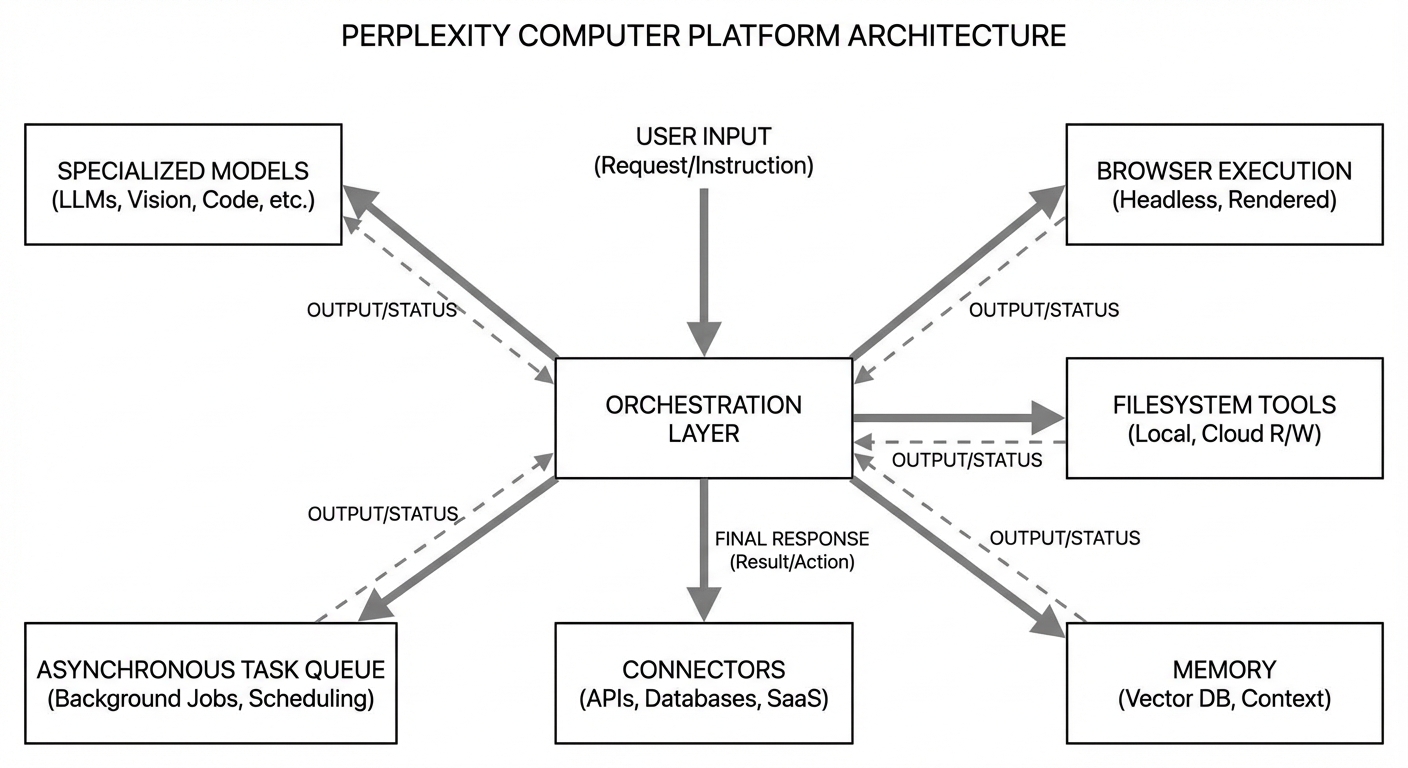
Architecture map showing Perplexity Computer orchestrating models, browser, filesystem, connectors, and memory into long-running agent workflows

Why This Is a Meaningful Shift in Agent Design

The phrase “agentic AI” has become ambiguous. For technical readers, the useful distinction is between interactive agents and execution agents. Interactive agents respond quickly in a conversational loop and may call tools in short bursts. Execution agents decompose goals, run asynchronous subworkflows, maintain continuity, and return integrated outputs after substantial unattended runtime. Perplexity Computer is explicitly positioned in the second category.

This distinction changes product value. Interactive agents improve local productivity for tasks like drafting, summarizing, and quick analysis. Execution agents target workflow ownership. They can absorb project overhead that currently sits between teams and systems: collecting references, generating intermediate artifacts, writing and running code, validating outputs, and iterating until constraints are met. The key metric is no longer response quality per prompt. It is completed work per unit of human attention.

That is where Perplexity’s framing is strategically sharp. If the product can run “for hours or even months” as quoted in launch coverage, the battleground moves from chatbot preference to orchestration reliability and control economics. The buyer question becomes operational: can this system finish meaningful work without requiring constant rescue.

Architecture: Multi-Model Orchestration as the Core Abstraction

In launch reporting, Srinivas emphasizes that Computer is “multi-model by design,” with model specialization treated like tool specialization. This mirrors how mature software systems treat infrastructure. A production stack does not use one database, one queue, one cache, and one runtime for every workload. It composes components based on workload characteristics. Agent systems are now following the same pattern.

From a systems viewpoint, this architecture has clear upside. First, it allows performance routing. High-complexity reasoning can go to models with stronger chain consistency, while deterministic transformations can go to faster and cheaper models. Second, it supports resilience. If one model has degraded performance, routing can shift without collapsing the whole workflow. Third, it supports cost optimization by assigning high-cost models only where their marginal quality is valuable.

The downside is orchestration complexity. Routing logic itself becomes a failure surface. Model interfaces differ, tool-calling behaviors differ, and failure semantics differ. If a workflow spans multiple agents and one sub-agent fails silently or returns malformed intermediate state, downstream steps may produce confident but invalid outputs. This is why the true quality signal will come from longitudinal workload data, not launch demos.

Isolated Compute Environments: Strong Claim, Hard Requirement

A second notable launch claim is isolated environments with real filesystem and browser access. If implemented with strong isolation boundaries, this addresses a major weakness in first-generation agents: weak execution realism. Many earlier systems could suggest code but could not reliably operate in an environment that resembled real project conditions. Real browser and filesystem access can close that gap.

Yet this also raises the security bar. Agent environments with broad connectors and execution permissions need rigorous controls around credential scope, outbound actions, data retention, audit trails, and rollback. Without robust policy layers, a capable agent can also be an efficient failure amplifier. Enterprises will evaluate this through governance controls, not only task completion rates.

This is where Perplexity’s enterprise trajectory matters. Comet enterprise materials emphasize secure deployment and organizational controls in browser contexts. If Computer inherits and extends those control primitives into agent workflows, the enterprise case strengthens. If controls are shallow relative to autonomy depth, adoption will be limited to low-risk and experimental workloads.

Business Model: Usage-Based Pricing Is Rational, but User Risk Moves Upstream

Perplexity’s launch framing around usage-based pricing is economically coherent for orchestration products. Multi-agent runs consume variable resources depending on task complexity, model selection, and runtime duration. A flat fee can hide cost until margins collapse, or enforce strict caps that cripple usefulness. Usage pricing aligns spend with work volume.

The practical issue is budget predictability. For end users and teams, orchestration depth can convert into cost volatility if tasks spawn many sub-agents or rerun loops after partial failures. Credit systems and spending caps help, but they are not enough by themselves. Serious users will need workload-level observability: per-run token cost, model mix, connector call volume, failure retries, and final output utility. Without this transparency, users cannot optimize behavior and procurement cannot govern spend effectively.

This is a structural trend across agent products in 2026. Capability marketing focuses on what agents can do. Operational adoption depends on whether teams can forecast and control what agents cost.

How Perplexity Computer Compares to the Current Agent Field

A direct benchmark is difficult because vendors publish uneven metrics and define “agent” differently. Still, the market can be segmented in a useful way. There are browser-embedded assistants, coding agents tied to repositories and CI, workflow automation platforms connected to SaaS ecosystems, and general-purpose orchestration systems that attempt to span all of the above. Perplexity Computer is targeting the fourth category.

The closest strategic comparison is not a single model release. It is any system that combines model routing, memory continuity, execution environments, and connectors into a goal-driven control plane. In this segment, differentiation will be decided by five factors: task decomposition quality, long-run reliability, security controls, cost governance, and integration breadth. Model quality still matters, but orchestration quality determines whether capability translates into delivered work.

Perplexity enters this race with two advantages. It already has strong user familiarity around research workflows and citation-oriented answer patterns. It also has clear product momentum around distribution layers such as Comet. The risk is that broad orchestration products can become operationally heavy quickly. They must maintain quality across many domains, not one narrow domain where optimization is easier.

Where the Launch Is Strong

The strongest element is architectural honesty. The company does not pretend one model solves all tasks. It acknowledges specialization and builds around orchestration. This is aligned with how advanced users already work manually, switching tools and models depending on the job. If the platform makes that switching automatic while preserving control, it solves a real friction point.

The second strong element is asynchronous orientation. Most productivity gain from agents will come from reducing synchronous supervision. A system that can run substantial work while a user is offline has materially different economic value than a system that requires constant prompting.

The third strong element is environment realism. Real browser and filesystem access support full-workflow execution rather than synthetic demos. If reliability holds, this can shift agent use from experimentation to production operations.

Where the Launch Is Exposed

The first exposure is reliability at duration. The longer a workflow runs, the more failure points accumulate. State drift, stale assumptions, connector timeouts, partial writes, and tool nondeterminism compound over time. Launch narratives emphasize multi-hour and multi-day execution, which increases scrutiny on durability metrics that are usually not visible in marketing materials.

The second exposure is safety and governance. Execution agents with broad permissions can create real-world side effects. This demands strict permissioning, explicit confirmation boundaries for sensitive actions, forensic logs, and policy constraints that are understandable by non-specialist operators.

The third exposure is user trust under cost uncertainty. Multi-model orchestration can produce excellent outcomes and unexpected bills at the same time. If users cannot predict spend by workload class, adoption will plateau outside high-value use cases.
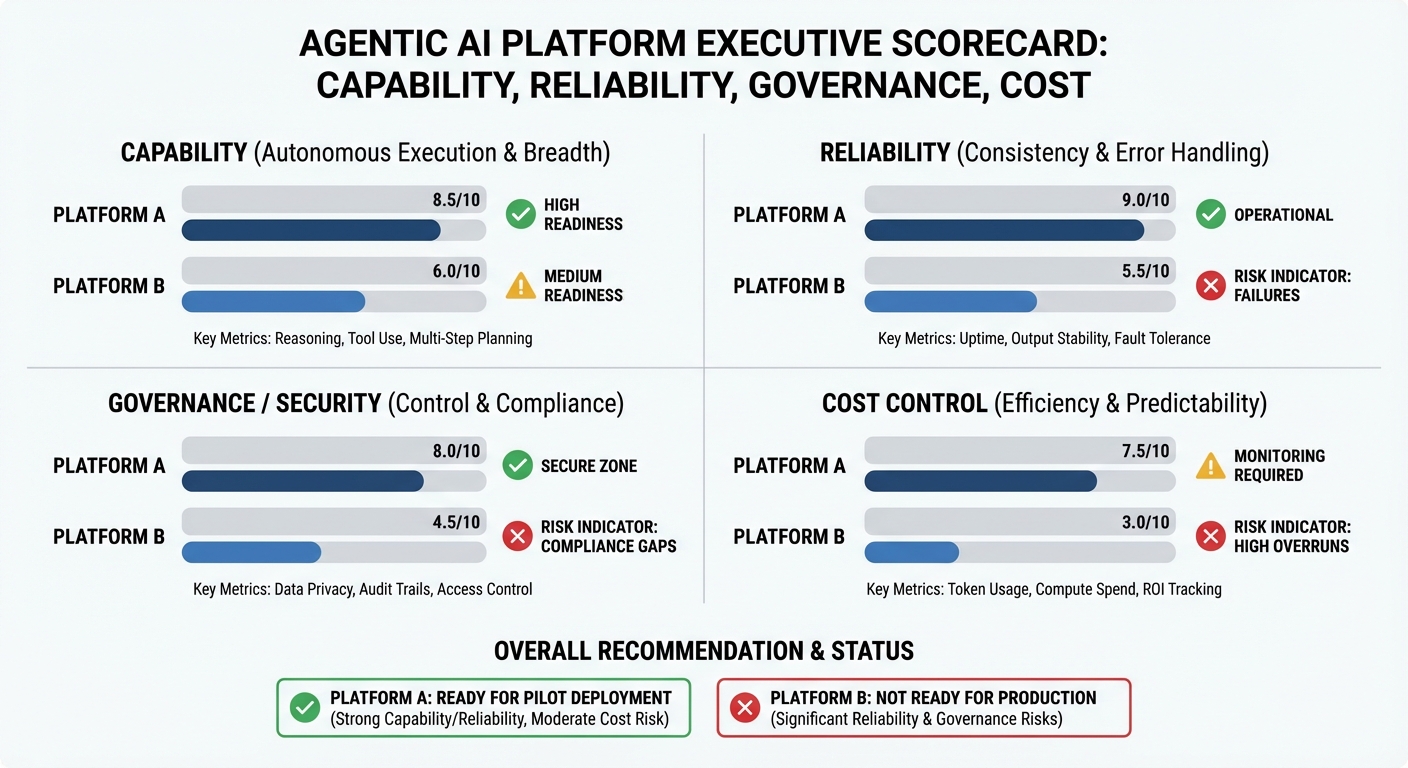
Operational scorecard visual for agentic systems comparing capability, reliability, security governance, and cost control

Evaluation Framework for Teams Adopting Computer

Teams evaluating Perplexity Computer should avoid binary judgments based on launch hype or skepticism. The correct approach is controlled workload testing. Start with three workload classes: bounded research tasks, deterministic build tasks, and mixed tasks with external connectors. Measure completion rate, correction burden, runtime variance, and total cost per completed outcome. Track failure modes in a structured taxonomy: decomposition errors, tool invocation errors, state propagation errors, and policy boundary violations.

Adoption should be phased by risk. Early deployment belongs in reversible workflows with low external side effects. High-impact actions such as production infrastructure changes, billing operations, or legal-communication outputs should stay behind stricter human checkpoints until reliability and governance data are mature.

From a procurement perspective, contract and platform discussions should include explicit controls: max spend per run, configurable model allowlists, retention and deletion controls, exportable logs, and environment-level isolation guarantees. This is not optional detail. It determines whether autonomous execution is governable at scale.

What This Means for the Next Phase of Agentic AI

Perplexity Computer reflects a market transition that now appears durable. The center of gravity is moving from assistant UX to execution systems. Competition is moving from “which model answers better” toward “which orchestration layer completes more work safely at predictable cost.” This favors product organizations that can combine model abstraction, systems engineering, and enterprise control surfaces in one coherent platform.

For users, this transition changes skill requirements. Prompt crafting remains useful, but orchestration literacy becomes more valuable: defining good outcomes, setting constraints, structuring evaluation loops, and diagnosing workflow failures. The operator of the next generation of agentic systems is less a prompt author and more a workflow architect.

For incumbents, the implication is direct. If orchestration becomes the primary product, model providers without strong control planes risk commoditization at the interface layer. For orchestration-first companies, the risk runs the other direction: if underlying model providers vertically integrate and close capability gaps, orchestration margins can compress. This strategic tension will define the next 12 to 24 months.

Twelve-Month Outlook: Realistic Scenarios

Base case: Computer becomes a high-leverage tool for technical users and power operators on specific workflow classes, with measured expansion to Pro and enterprise after reliability tuning. Adoption grows where asynchronous execution and multi-model routing provide obvious ROI.

Upside case: Perplexity demonstrates strong reliability at long runtime, introduces enterprise-grade governance controls quickly, and becomes a default orchestration layer for cross-domain knowledge work. In this case, the product redefines expectations for what “agentic” should mean in commercial software.

Downside case: Reliability variance, opaque cost behavior, or security-control gaps limit trust for mission-critical workflows. Product remains impressive for demos and selective use, but does not cross into broad operational dependency.

Current evidence supports base-case optimism with significant unresolved operational questions. That is a strong launch position, but not a solved execution story.

Key Takeaways

  • Perplexity Computer is positioned as an orchestration system, not a single-model assistant.
  • Launch claims emphasize 19-model routing, isolated execution environments, real browser and filesystem access, and asynchronous long-running workflows.
  • The strategic shift is from response quality per prompt to completed outcomes per unit of human attention.
  • Main strengths are architectural realism, asynchronous execution model, and multi-model flexibility.
  • Main risks are long-run reliability, governance depth, and spend predictability under usage-based pricing.
  • The next phase of agentic competition will be decided by orchestration quality, control surfaces, and cost governance rather than model branding alone.

Sources

Keywords

Perplexity, Computer, agentic, AI, orchestration, models, workflow, automation, browser, enterprise, pricing, reliability

Stay Connected

Follow us on @leolexicon on X

Join our TikTok community: @lexiconlabs

Watch on YouTube: @LexiconLabs

Learn More About Lexicon Labs and sign up for the Lexicon Labs Newsletter to receive updates on book releases, promotions, and giveaways.

Perplexity's Breakout Strategy: Disrupting AI Search and Advertising

Perplexity's Breakout Strategy: Disrupting AI Search and Advertising

Quick take: Perplexity's Breakout Strategy remains highly relevant because it affects long-term technology adoption, education, and decision-making. This guide focuses on practical implications and what to watch next.

The emergence of artificial intelligence in search technology has prompted companies to rethink traditional business models. Perplexity, an AI-driven search engine, has captured the spotlight with its bold advertising strategy that is poised to reshape the future of search and digital marketing. 

Explore Lexicon Labs Books

Discover current releases, posters, and learning resources at http://lexiconlabs.store.

Conversion Picks

If this AI topic is useful, continue here:


This blog post explores the unique approach adopted by Perplexity, examines the underlying factors that have spurred its success, and explores how this breakthrough strategy is challenging long-established industry giants. By integrating data, case studies, and expert commentary, this post offers an in-depth look at how Perplexity is redefining the way businesses and consumers interact with AI-powered search platforms (Okoone, 2024; CNBC, 2024).

Introduction to AI-Powered Search and Advertising

The digital ecosystem is undergoing a transformation as artificial intelligence continues to infiltrate everyday technology. Search engines, once driven solely by keyword algorithms and link analysis, are now harnessing advanced AI to deliver more intuitive and context-aware results. Perplexity stands at the forefront of this revolution by combining state-of-the-art AI with an innovative advertising model that challenges conventional practices. This shift not only enhances user experience by providing more accurate search results but also creates new opportunities for advertisers to reach targeted audiences in real time. As businesses increasingly rely on AI to capture consumer attention, Perplexity’s approach signals a significant paradigm shift in both search technology and digital marketing (TechCrunch, 2024).

Over the past few years, the digital advertising market has seen tremendous growth. Recent estimates suggest that global digital advertising spending has exceeded hundreds of billions of dollars annually. With such a vast market, even incremental innovations in how search engines integrate advertising can have far-reaching implications. Perplexity’s breakout strategy leverages the latest advancements in machine learning and data analytics to offer a more engaging, efficient, and cost-effective alternative to traditional search advertising methods (Marketing Dive, 2024). By harnessing AI, Perplexity is not only refining search results but is also delivering ads that are highly relevant to user queries, thereby driving higher engagement and conversion rates.

The Evolution of AI in Search Engines

The journey of artificial intelligence in search began with simple algorithms that indexed and ranked web pages based on keywords. Over time, these algorithms evolved to incorporate semantic analysis and natural language processing, paving the way for more sophisticated search engines. Today, AI-driven search platforms can understand context, learn from user behavior, and adapt in real time, making the search process more intuitive and responsive.

Perplexity is one such platform that has capitalized on these technological advancements. By integrating neural networks and deep learning models, the company has built a search engine that can interpret complex queries and deliver personalized results. This is a stark contrast to legacy search engines, which often struggle to keep pace with rapidly changing consumer expectations. Perplexity’s innovative approach has attracted attention from both industry insiders and digital marketers, positioning the company as a potential disruptor in a market dominated by long-established players (Okoone, 2024).

Perplexity.ai employs a bundling strategy by integrating multiple large language models (LLMs) into a single, unified platform. This approach allows users to tap into the distinct strengths of each LLM through one interface. By offering diverse models, the platform caters to different response styles—one model may provide concise summaries while another offers in-depth explanations—thereby enhancing overall answer quality. Bundling multiple LLMs reduces the friction of having to subscribe to or learn separate systems, ultimately streamlining the user experience and providing comprehensive, multi-faceted perspectives on queries. 

Perplexity's Bold Advertising Move

At the core of Perplexity’s strategy lies a daring advertising initiative that deviates from the conventional pay-per-click model. Instead of relying on traditional ad placements that interrupt the user experience, Perplexity integrates advertisements directly into the search experience in a way that is both seamless and informative. This move is designed to provide value to the user while simultaneously offering advertisers a unique channel to showcase their products and services.

According to recent reports, Perplexity’s advertising strategy involves contextualizing ads within the natural flow of search results. This approach not only minimizes disruption but also enhances the likelihood that users will engage with the content. For example, if a user searches for information on a specific product, the AI system can deliver an advertisement that is closely related to that query, thereby increasing relevance and potential conversion. This innovative method is a departure from the more intrusive advertising formats seen on many traditional search platforms and signals a broader shift towards user-centric digital marketing (CNBC, 2024).

The company’s CEO, Aravind Srinivas, has been vocal about the transformative potential of this strategy. In a recent CNBC interview, Srinivas emphasized that Perplexity’s focus is on creating a symbiotic relationship between search functionality and advertising. By leveraging real-time data and advanced machine learning, Perplexity is able to predict user intent with remarkable accuracy, ultimately driving more efficient ad placements and a better overall user experience (CNBC, 2024).

Recently, Perplexity integrated DeepSeek R1 by hosting the open‐source model on secure U.S. and European servers and incorporating it into its Pro offering. Users can activate this feature via a “Reasoning with R1” mode available on the platform, which delivers more detailed and logical responses for complex queries. This integration allows Perplexity to combine the advanced reasoning and problem‐solving strengths of DeepSeek R1 with its own search capabilities—providing richer, context-aware answers while ensuring that user data is processed in compliance with Western data protection standards 

To achieve this, Perplexity’s team undertook extensive post-training to overcome the censorship biases inherent in the original DeepSeek model. They curated a large dataset of sensitive prompts—covering over 300 topics—and applied fine-tuning techniques using frameworks like Nvidia’s NeMo 2.0 to “Americanize” the responses. The result is a model that retains DeepSeek’s powerful reasoning abilities while producing neutral, fact-based answers on topics that were previously subject to censorship, ultimately enhancing deep web research and offering a more secure and reliable user experience

Data-Driven Insights and Case Studies

Empirical evidence and data analytics play a crucial role in validating Perplexity’s strategic direction. Recent studies have shown that AI-powered search engines can significantly reduce bounce rates and increase user engagement by delivering more relevant content. In one study, early adopters of Perplexity’s advertising model reported a measurable improvement in click-through rates (CTRs) and conversion metrics compared to traditional search advertising techniques (Search Engine Journal, 2024).

In addition to improved engagement metrics, case studies have highlighted the scalability of Perplexity’s approach. One notable example involved a mid-sized e-commerce company that integrated Perplexity’s advertising platform into its digital marketing strategy. Within the first three months, the company observed a 35% increase in organic traffic and a 25% boost in conversion rates. These improvements were attributed to the platform’s ability to seamlessly merge advertising content with user queries, thereby enhancing the overall shopping experience (Marketing Dive, 2024).

Furthermore, data from various market research firms indicate that the global digital advertising market is trending towards AI-driven solutions. With an anticipated compound annual growth rate (CAGR) exceeding 20% over the next few years, the shift towards machine learning-powered advertising models is not only inevitable but also necessary for companies looking to stay competitive (TechCrunch, 2024). Perplexity’s innovative approach, which merges AI search with integrated advertising, is well-positioned to capture a significant share of this expanding market.

Competitive Landscape and Market Impact

The introduction of Perplexity’s breakout strategy has not gone unnoticed by industry giants. Established search engines and advertising platforms have long relied on conventional methods that often interrupt the user experience with unrelated ads. However, the integration of AI to deliver highly contextualized and relevant advertisements represents a fundamental shift in the way search and advertising are conceived.

Competitors are now compelled to re-evaluate their own strategies in response to Perplexity’s success. For instance, traditional search engines are beginning to experiment with AI-powered solutions to refine their ad placements and improve user engagement. The ripple effect of Perplexity’s strategy is evident in the increasing number of companies that are investing heavily in AI research and development to enhance their digital marketing capabilities (Okoone, 2024).

Market analysts suggest that the disruptive nature of Perplexity’s approach could lead to a significant reallocation of advertising dollars in the near future. Advertisers are becoming more discerning, seeking platforms that offer not only visibility but also a measurable return on investment (ROI). By providing a seamless and integrated advertising experience, Perplexity is attracting a diverse range of advertisers—from small startups to large multinational corporations—each eager to capitalize on the efficiency and precision of AI-driven ad placements (Search Engine Journal, 2024).

This shift in advertising dynamics is also prompting a broader discussion about the future of digital marketing. As user preferences evolve and the demand for personalized content increases, companies must adapt their strategies to remain relevant. Perplexity’s innovative model serves as a blueprint for how AI can be leveraged to create more engaging, non-intrusive advertising experiences that benefit both consumers and marketers (Marketing Dive, 2024).

Challenges and Potential Pitfalls

Despite the promising outlook, Perplexity’s bold strategy is not without its challenges. Integrating AI into the core of search and advertising involves complex technological, ethical, and operational considerations. One of the primary challenges lies in ensuring the accuracy and reliability of AI predictions. While machine learning algorithms have made significant strides in understanding user intent, they are not infallible. Misinterpretations of queries or inappropriate ad placements could lead to user dissatisfaction and potential revenue loss for advertisers.

Another potential pitfall is the issue of data privacy. As AI systems rely on large volumes of user data to fine-tune their algorithms, there is an inherent risk of compromising user privacy if data is not managed responsibly. Companies like Perplexity must navigate increasingly stringent data protection regulations while still delivering personalized content. Failure to balance these demands could result in legal challenges and a loss of consumer trust (CNBC, 2024).

Furthermore, the competitive pressure from established players in the search and advertising sectors cannot be underestimated. Giants with deep pockets and extensive resources may quickly adapt to the changing landscape by developing their own AI-driven solutions or by acquiring innovative startups like Perplexity. This dynamic environment necessitates continuous innovation and strategic foresight to maintain a competitive edge (TechCrunch, 2024).

In addition to these challenges, there is also the risk associated with scaling operations. As demand for AI-powered advertising increases, Perplexity must ensure that its infrastructure can handle the growing volume of data and maintain high performance standards. This requires ongoing investment in technology and talent, as well as the development of robust systems for real-time analytics and feedback.

The Future of AI Search and Advertising

The rapid evolution of AI technology suggests that the future of search and advertising is bright, yet unpredictable. Perplexity’s breakout strategy is a harbinger of what is to come—a landscape where AI seamlessly integrates search functionality with digital marketing to create a user experience that is both personalized and unobtrusive. As machine learning models become more refined and data analytics more sophisticated, the potential for innovation in this space is limitless.

Looking ahead, several trends are likely to shape the future of AI search advertising. First, there will be an increased focus on hyper-personalization, where advertisements are not just contextually relevant but are tailored to the individual characteristics and preferences of each user. This level of customization will be made possible by advances in natural language processing and real-time data analytics, further blurring the lines between content and advertising (Marketing Dive, 2024).

Second, the integration of augmented reality (AR) and virtual reality (VR) into digital marketing strategies is poised to revolutionize the way consumers interact with advertisements. Imagine a scenario where a user searching for home décor ideas is not only presented with relevant search results but is also offered an immersive AR experience that allows them to visualize products in their own space. Such innovations could radically transform the advertising landscape, creating new opportunities for engagement and revenue generation.

Third, the rise of voice-activated search and smart assistants is set to add another layer of complexity to AI-driven advertising. As more consumers turn to devices like smart speakers for their information needs, advertisers will need to adapt their strategies to this emerging medium. Voice search relies heavily on conversational AI, which means that ad content must be designed to interact naturally with users while still delivering the intended marketing message (CNBC, 2024).

Finally, regulatory and ethical considerations will continue to influence the development of AI advertising. As governments around the world implement stricter data privacy and security laws, companies will be required to innovate within these constraints. The ability to provide personalized, AI-driven experiences while safeguarding user data will be a key differentiator for companies in this space.

Industry Reactions and Broader Implications

The announcement of Perplexity’s breakthrough strategy has sparked widespread discussion among industry experts and digital marketers alike. Some have hailed the move as a visionary step that could redefine the way search engines operate, while others remain cautious about the potential risks and challenges associated with such rapid innovation. Regardless of these differing perspectives, one point is clear: the digital advertising landscape is undergoing a significant transformation.

Industry leaders are now examining how they can incorporate similar AI-driven models into their own platforms. For instance, several established search engines have initiated research projects aimed at integrating machine learning with their ad delivery systems. This proactive stance suggests that Perplexity’s strategy may well serve as a catalyst for broader industry-wide changes (Okoone, 2024).

Moreover, the implications of this shift extend beyond the realm of advertising. Enhanced AI capabilities in search engines have the potential to improve overall user satisfaction by delivering more accurate, context-aware search results. As users benefit from a more intuitive search experience, the demand for high-quality, personalized content is likely to increase. This could lead to a virtuous cycle in which improved search results drive higher engagement, which in turn fuels further innovation in AI technologies.

For advertisers, the transition to AI-driven platforms represents an opportunity to achieve better alignment between marketing spend and return on investment. By leveraging data-driven insights, advertisers can fine-tune their campaigns to target the most relevant audiences at optimal times. This efficiency is particularly valuable in a market where every click, impression, and conversion is critical to overall performance (Search Engine Journal, 2024).

Key Takeaways

Perplexity’s breakout strategy offers several key insights that are relevant for digital marketers, technology enthusiasts, and industry stakeholders alike. First, the integration of AI into search engines is not just about improving search results; it is also about redefining the way advertisements are delivered. Second, by embedding ads within the natural search flow, Perplexity is able to enhance user experience while delivering measurable business outcomes for advertisers. Third, data-driven strategies and case studies confirm that AI-powered platforms can drive significant improvements in engagement and conversion metrics. Finally, while the path forward is promising, it is not without challenges, and companies must navigate issues related to data privacy, technological scalability, and competitive pressures.

Conclusion

Perplexity’s bold move to integrate AI-driven search with an innovative advertising strategy represents a watershed moment in the evolution of digital marketing. By rethinking the traditional paradigms of search and advertisement, the company is setting a new standard for what is possible in the intersection of technology and marketing. The confluence of advanced machine learning algorithms, real-time data analytics, and a user-centric approach has positioned Perplexity as a disruptive force with the potential to reshape an industry that has long been dominated by a few key players.

As digital advertising continues to evolve, the success of Perplexity’s strategy will likely serve as a blueprint for other companies seeking to leverage AI for competitive advantage. The challenges are significant, but so too are the opportunities. For consumers, this means a more seamless and personalized search experience; for advertisers, a more effective and efficient way to reach their target audiences; and for the industry at large, a glimpse into the future of AI-powered marketing.

In summary, Perplexity’s strategy is a deliberate, data-driven approach that is poised to have far-reaching implications for the future of AI search and digital advertising. By harnessing the power of artificial intelligence, the company is driving innovation that stands to benefit businesses and consumers alike, ultimately contributing to a more dynamic and efficient digital ecosystem (Okoone, 2024; CNBC, 2024; TechCrunch, 2024; Marketing Dive, 2024; Search Engine Journal, 2024). This unique strategy is a clear example of how innovative approaches in artificial intelligence can disrupt established industries. By integrating advanced AI techniques with a user-centric advertising model, Perplexity is setting new standards in digital marketing and search technology. The bold move not only enhances the user experience by providing relevant and contextual ads but also delivers tangible business benefits by driving higher engagement and improved conversion metrics. As the industry continues to evolve, companies that embrace such data-driven innovations will be best positioned to lead the digital transformation, ensuring that both advertisers and consumers reap the rewards of a more intelligent and responsive online ecosystem.

References

Check our posts & links below for details on other exciting titles. Sign up to the Lexicon Labs Newsletter and download your FREE EBOOK!


Related Reading

Stay Connected

Follow us on @leolexicon on X

Join our TikTok community: @lexiconlabs

Watch on YouTube: @LexiconLabs

Learn More About Lexicon Labs and sign up for the Lexicon Labs Newsletter to receive updates on book releases, promotions, and giveaways.

Welcome to Lexicon Labs

Welcome to Lexicon Labs: Key Insights

Welcome to Lexicon Labs: Key Insights We are dedicated to creating and delivering high-quality content that caters to audiences of all ages...