Showing posts with label autonomy. Show all posts

Tesla FSD and Safety: By the Numbers

Tesla FSD and Safety: By the Numbers

On February 18, 2026, Tesla said its drivers had crossed 8 billion cumulative miles on Full Self-Driving (Supervised). The company has framed this as progress toward a threshold Elon Musk has repeatedly described as necessary for safe unsupervised autonomy: roughly 10 billion miles of real-world experience. That framing sounds simple. More miles equals better software. But the real safety picture is not one number. It is a stack of different numbers measured in different operating conditions, with different definitions of what counts as an incident, and different levels of human backup still in the loop.

Explore Lexicon Labs Books

Discover current releases, posters, and learning resources at http://lexiconlabs.store.

Conversion Picks

If this AI topic is useful, continue here:

That is exactly why this topic matters now. Tesla is scaling FSD usage, has launched a paid robotaxi service in Austin, and is preparing Cybercab production. At the same time, critics are tracking reported crashes in robotaxi operations, and competitors like Waymo are publishing their own large-scale driverless safety results. So the right question is not whether 8 billion miles is impressive. It is. The right question is what those miles do and do not prove about safety today.

This breakdown focuses on what we can verify as of February 2026, including Tesla and Waymo disclosures, federal reporting context, and third-party analyses built from public filings. The goal is not hype or dunking. The goal is decision-grade clarity.
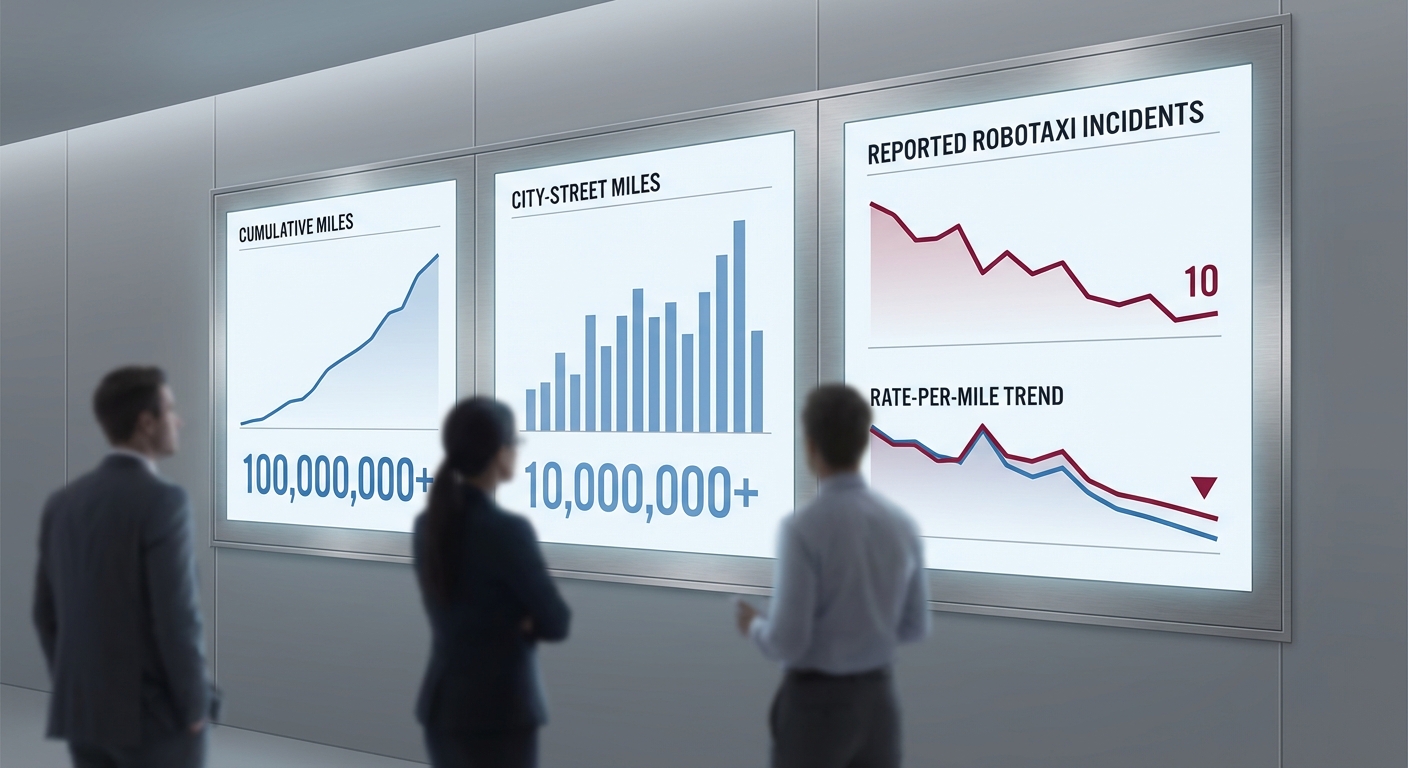
Dashboard comparing Tesla FSD cumulative miles, robotaxi incidents, and benchmark safety rates

The Headline Number: 8 Billion FSD Miles

Tesla-linked reporting and market coverage on February 18, 2026 state that the fleet surpassed 8 billion cumulative miles on FSD (Supervised), with more than 3 billion of those miles on city streets. That city-street split matters because urban driving includes more edge cases: unprotected left turns, pedestrians stepping into lanes, bikes and scooters, odd curb geometry, parked delivery vehicles, temporary construction patterns, and more non-compliant agent behavior. In other words, city miles are generally information-dense miles.

Still, cumulative fleet miles are not a direct safety score. They are a learning-input metric. They tell us the system has been exposed to large volumes of real-world variation. They do not automatically tell us intervention frequency, injury risk, or severity distribution in commercial driverless operations. A system can improve rapidly with data and still underperform in a specific operational domain, especially when that domain shifts from supervised consumer use to commercial autonomy.

That distinction becomes critical in 2026 because Tesla is operating across at least three practical layers: consumer FSD (supervised), supervised robotaxi operations, and initial no-safety-monitor rides in limited cases. The safety expectation for each layer is different.

What Tesla Is Trying to Prove with 10 Billion Miles

Musk has argued that unsupervised autonomy requires enough data to cover what he calls reality’s long tail. Conceptually, that argument is reasonable. Rare events dominate failure risk in autonomous systems. If a model has not seen enough combinations of weather, road markings, unpredictable human behavior, emergency vehicles, occlusions, and odd local traffic norms, it will fail in places that look routine to human drivers. More high-quality data can shrink those blind spots.

But there are two limits to this argument. First, not all miles are equally valuable. Ten million low-complexity highway miles at low interaction density do not buy the same long-tail coverage as ten million dense urban miles with diverse road users. Second, quality of labels and feedback loops matter as much as raw distance. If intervention and near-miss events are not captured, categorized, and fed back effectively, mileage growth can overstate learning progress.

So 10 billion is better interpreted as a scale signal than a guarantee threshold. It may indicate Tesla can train on increasingly broad scenarios. It does not, on its own, close the case on safe unsupervised deployment.

Robotaxi Safety Scrutiny in Austin

Now to the number driving most of the safety debate. Reporting based on NHTSA-filed crash disclosures says Tesla added five robotaxi incidents in December 2025 and January 2026, bringing the disclosed total to 14 incidents since the Austin service launch in June 2025. The same reporting estimates around 800,000 paid robotaxi miles by mid-January, implying approximately one crash per 57,000 miles in that commercial operation window.

A widely cited comparison in that reporting uses Tesla’s own benchmark that human drivers average a minor collision roughly every 229,000 miles. On that framing, robotaxi crashes appear roughly 4x more frequent than Tesla’s human baseline. Even if one debates exact comparability, this is enough to justify close monitoring. It is not a noise-level deviation.

The details of the newly disclosed events also matter: reported incidents include contact with a stationary bus, a heavy truck, fixed objects, and low-speed backing collisions. None of these are the cinematic high-speed edge cases people imagine when discussing autonomy. They are exactly the “boring but hard” operational interactions that should improve first in mature urban deployments.

Another important detail from coverage of the filings is that an earlier report was revised to add a hospitalization injury. Revisions in reported severity are not unusual in incident reporting systems, but they are important for interpreting trend quality. If severity classifications shift after initial filing, stakeholders need to track updates, not just first-published counts.

Why the Robotaxi vs Consumer FSD Comparison Is Tricky

A common mistake is to compare total consumer FSD miles directly with robotaxi incident rates and draw sweeping conclusions. These are different use cases and exposure profiles. Consumer supervised driving includes massive diversity in driver attention, route selection, takeover behavior, and local usage patterns. Robotaxi operations are more controlled but also concentrate on dense service geographies and repeated urban pickup-dropoff workflows where low-speed interactions are constant.

In addition, supervised consumer miles include a human who is explicitly expected to monitor continuously. Robotaxi safety should be judged against commercial autonomy standards, not consumer-assist framing. As soon as no-monitor rides enter service, scrutiny should tighten further. The burden of proof changes from “assistive system that can make mistakes while a human is responsible” to “service that must maintain safety margins in real time without immediate human fallback.”

What NHTSA Reporting Does and Does Not Tell You

NHTSA’s Standing General Order crash framework is essential, but it is not a complete scoreboard for relative AV safety. It is best used as a transparency channel and early warning system. The agency itself emphasizes that crash reports under this framework are not normalized exposure-adjusted rankings of one company versus another. Reporting triggers, fleet sizes, operating design domains, and miles driven differ substantially.

That means you can responsibly use SGO-linked data to track trend direction, incident typology, and severity developments, but not to make simplistic “winner/loser” claims without denominator context. If a service triples its miles while incidents rise modestly, risk per mile may improve even if raw incident counts rise. Conversely, if mileage is small and incident counts jump, concern can be justified quickly.

In Tesla’s case, the current debate is exactly this denominator problem. The fleet-level FSD denominator is enormous. The commercial robotaxi denominator is still relatively small. Policy and public trust outcomes will likely be driven more by the second denominator than the first.
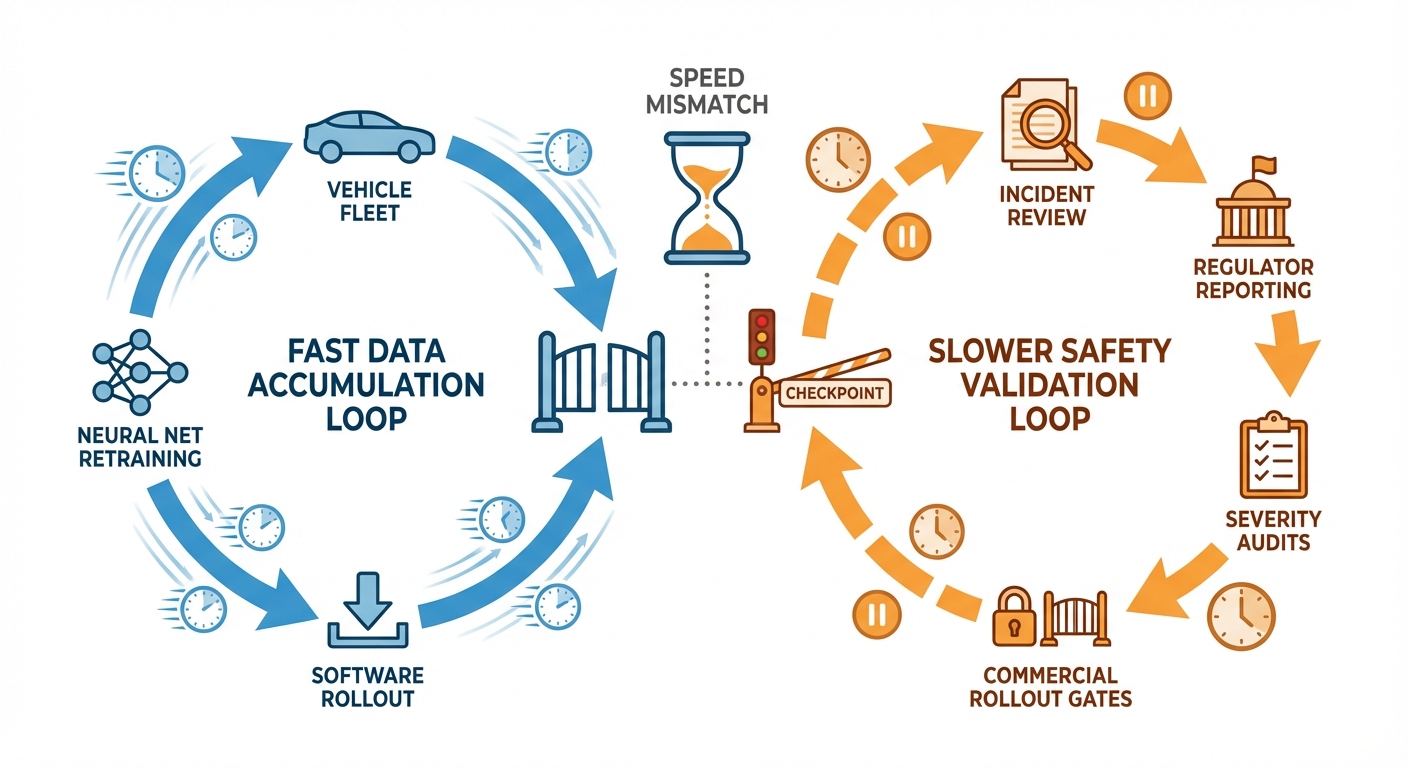
Conceptual chart showing gap between fast software data accumulation and slower safety validation in commercial autonomy

Tesla vs Waymo: Why This Comparison Is Everywhere

Waymo says it has crossed 127 million rider-only miles and over 10 million rider-only trips as of February 2026, with no human in the driver seat. That is a very different operating claim from supervised systems. It is also why investors, regulators, and the public increasingly frame this race as one between two autonomy philosophies: broad supervised scale first (Tesla) versus constrained but driverless ODD expansion (Waymo).

The most useful way to compare them is not ideological. It is operational:

  • Tesla strength: unmatched supervised mileage scale, rapid software iteration, and vertically integrated hardware-production stack.
  • Tesla challenge: converting supervised fleet learning into consistently lower incident rates in commercial no-monitor operations.
  • Waymo strength: large, disclosed rider-only base with long-running driverless operations in geofenced domains.
  • Waymo challenge: scaling footprint, economics, and vehicle throughput while keeping safety deltas favorable.

In short, Tesla is proving breadth. Waymo is proving depth in selected zones. Markets, regulators, and cities will decide over time which proof carries more weight for different deployment types.

How to Read Tesla’s Safety Story Without Getting Misled

There are four numbers you should watch together each quarter rather than in isolation.

  • Cumulative supervised FSD miles: measures training and exposure scale.
  • Commercial robotaxi miles: measures size of real driverless business exposure.
  • Incident rate per mile in robotaxi operations: the most decision-relevant operational safety metric for service rollout.
  • Severity distribution: property damage-only, injury, hospitalization, and event context.

If cumulative miles rise quickly but robotaxi incident rate does not decline meaningfully, the autonomy thesis weakens in the near term. If robotaxi rates improve steadily while no-monitor miles expand, the thesis strengthens materially, even if raw incident counts still rise during scale-up.

The Near-Term Milestones That Matter Most in 2026

Tesla’s next milestones are unusually clear. First, progress from 8 billion toward 10 billion supervised miles. Second, operational data from expanding no-monitor rides. Third, Cybercab production readiness and service integration. A manufacturing launch can increase deployment potential fast, but it also amplifies safety-accountability pressure because exposure can scale before public confidence catches up.

This is where communication quality matters. If Tesla wants to win the public trust race, it needs more than milestone headlines. It needs durable, repeatable, denominator-aware reporting that makes it easy for independent observers to evaluate trend direction without reverse engineering from fragmented filings.

Bottom Line: Is Tesla Safer Yet?

The data supports two statements at once.

First, Tesla has achieved a remarkable supervised learning scale milestone. Eight billion FSD miles, including billions in city environments, is a real technical asset and likely a meaningful advantage in rare-scenario discovery. Second, early robotaxi incident-rate analysis in Austin, based on publicly reported filings and paid-mile estimates, raises legitimate safety questions that cannot be dismissed by cumulative fleet miles alone.

So the honest answer is this: Tesla may be building the ingredients for safe unsupervised autonomy, but the current commercial robotaxi evidence remains mixed. The next six to twelve months will matter more than any single cumulative mileage milestone because this is the period where supervised learning claims must translate into better real-world commercial safety ratios.

Key Takeaways

  • Tesla’s reported 8 billion FSD miles is a major scale milestone, but it is a training-input metric, not a standalone safety verdict.
  • Coverage of NHTSA-filed robotaxi incidents indicates 14 disclosed crashes since June 2025 in Austin, with an estimated one crash per 57,000 miles by mid-January 2026.
  • Comparisons to human-driver benchmarks depend heavily on matching conditions, denominator quality, and severity definitions.
  • NHTSA SGO data is critical for transparency but should be treated as directional safety surveillance, not a normalized league table.
  • Waymo’s reported 127 million rider-only miles without a driver sets a high benchmark for commercial driverless validation.
  • The most important 2026 question is whether Tesla’s robotaxi incident rate improves as no-monitor miles and service scale increase.

Sources

Keywords

Tesla, FSD, robotaxi, autonomy, safety, crash, miles, Waymo, NHTSA, Cybercab, Austin, AI

Related Reading

Stay Connected

Follow us on @leolexicon on X

Join our TikTok community: @lexiconlabs

Watch on YouTube: @LexiconLabs

Learn More About Lexicon Labs and sign up for the Lexicon Labs Newsletter to receive updates on book releases, promotions, and giveaways.

Self-Learning AI in Video Games: Adapting to Player Behavior

AI in Video Games: Transforming the Player Experience

Real-Time Adaptation with Self-Learning AI

In modern video games, self-learning artificial intelligence (AI) enables developers to create dynamic environments that respond to player actions in real-time. Powered by advanced machine learning algorithms, these AI systems can analyze player behavior and make on-the-fly adjustments, offering a personalized experience that evolves with each play session. From changing NPC behavior to adjusting game difficulty, AI is reshaping how players engage with games.

Explore Lexicon Labs Books

Discover current releases, posters, and learning resources at http://lexiconlabs.store.

Conversion Picks

If this AI topic is useful, continue here:

Self-Learning AI in Video Games: Adapting to Player Behavior image 1

Enhanced Immersion and Storytelling

Self-learning AI not only impacts gameplay mechanics but also enhances narrative experiences. By analyzing player decisions, AI can adapt storylines, challenges, and rewards to better suit individual play styles. Developers like Unity Technologies and EA’s Frostbite engine are already utilizing AI to create more immersive worlds where narratives are shaped dynamically based on player interaction. This adaptive storytelling fosters deeper engagement and allows for replayable experiences that feel fresh and personalized every time.

The Evolution of NPCs: From Static to Dynamic

AI-driven NPCs (non-playable characters) have become more sophisticated, thanks to self-learning algorithms. No longer static, these characters can evolve over time, responding intelligently to player choices. Whether as allies or adversaries, NPCs now exhibit lifelike behaviors, contributing to a richer, more believable game world. Game developers like Rockstar Games and CD Projekt Red have leveraged AI to create memorable characters in titles like *Red Dead Redemption* and *Cyberpunk 2077*, making players feel more connected to the game world.

The Future of AI in Gaming

As technology advances, the role of self-learning AI in gaming will only grow. Companies like DeepMind and OpenAI continue to push the boundaries, bringing players closer to adaptive, evolving games. Whether through intelligent NPCs, tailored narratives, or dynamic challenges, AI is set to play a central role in the next generation of video games, offering players experiences that grow and change with them.

To explore more about AI in gaming, visit resources from DeepMind, OpenAI, and game engines like Unity and Unreal Engine, which are leading the development of smarter, more immersive game worlds.


Stay Connected

Follow us on @leolexicon on X

Join our TikTok community: @lexiconlabs

Watch on YouTube: Lexicon Labs


Newsletter

Sign up for the Lexicon Labs Newsletter to receive updates on book releases, promotions, and giveaways.


Catalog of Titles

Our list of titles is updated regularly. View the full Catalog of Titles on our website.

Related Reading

Stay Connected

Follow us on @leolexicon on X

Join our TikTok community: @lexiconlabs

Watch on YouTube: @LexiconLabs

Learn More About Lexicon Labs and sign up for the Lexicon Labs Newsletter to receive updates on book releases, promotions, and giveaways.

Teens Mean Business: The Rise of Teen Entrepreneurship


Teens Mean Business: The Rise of Teen Entrepreneurship

Quick take: Teens Mean Business remains highly relevant because it affects long-term technology adoption, education, and decision-making. This guide focuses on practical implications and what to watch next.

The rise of teenage entrepreneurship has been a noteworthy trend over the past decade. A report by the Small Business Administration found that in 2018, 9 out of 10 startups were owned by people aged 20-39, but an increasing number of teens are now launching their own ventures (SBA, 2019). Here is a slightly academic take on the key motivations driving teen entrepreneurs, the challenges they face, and important lessons for achieving success.

Explore Lexicon Labs Books

Discover current releases, posters, and learning resources at http://lexiconlabs.store.

Conversion Picks

Want more from Lexicon Labs? Continue with these reader favorites:

Why Are More Teens Becoming Entrepreneurs?

  1. Desire for autonomy and independence A primary reason many teens start businesses is to gain a sense of control over their lives (Geldhof et al., 2014). Entrepreneurship allows them to set their own schedules, work at their own pace, and steer their own futures. This is especially appealing for teenagers who are still forming their identities and want to feel empowered. As a teen entrepreneur herself, Maya Penn says "Entrepreneurship is one of the most powerful tools we have as young people to craft the lives and careers we want for ourselves." (Penn, 2016)

  2. Financial motivations Many teens see entrepreneurship as a path to earning money, paying for college, or funding their passions (Drnovsek & Erikson, 2005). Social media and online platforms have made it easier than ever to start a low-overhead business. An example is influencer marketing, where teens can monetize content without needing a physical storefront or inventory.

  3. Creative outlet Some teenage entrepreneurs are driven by a desire to express their creativity through art, music, writing, or other pursuits. Turning those passions into a business allows them to share their talents and build a community around their work. A 2019 survey by Junior Achievement found that 60% of teens would consider starting a business related to something they love doing (Junior Achievement, 2019).

Challenges Faced by Teenage Entrepreneurs

  1. Limited experience and knowledge One of the biggest hurdles for teen entrepreneurs is their lack of business experience compared to adults (Schaeff et al., 2017). Many struggle with fundamental business activities like accounting, marketing, and managing suppliers/vendors. As 18-year-old CEO Abby Kircher notes, "There's no class in high school on how to start a company. I had to learn everything as I went." (Kiser, 2016)

  2. Maturity and self-discipline Entrepreneurship demands maturity, responsibility and self-regulation - traits that are still developing in adolescents (Von Graevenitz et al., 2010). Without guidance from mentors or a support system, some teens battle procrastination, lack of motivation, and rash decision-making. A 2020 study on teen entrepreneurs found that "the need for autonomy, self-realization and role models positively influences entrepreneurial intention, while the aversion to stress negatively affects it." (Barba-Sánchez & Molina, 2020)

Key Lessons for Teen Entrepreneurial Success

  1. Passion alone is not enough While passion is critical, teen entrepreneurs must also develop concrete business skills in areas like market research, financial planning, and promotion (Honig, 2004). Resources like the Young Entrepreneurs Academy and Junior Achievement provide training programs to help bridge this knowledge gap.

  2. Network and build relationships
    Connecting with fellow entrepreneurs, industry professionals and potential mentors is vital for teens starting a business (Greve & Salaff, 2003). Joining entrepreneur clubs, attending conferences, and participating in online forums are great ways to grow their networks. Elena Schick, who started her nonprofit at 15, says "I wouldn't be where I am today without my mentors. Their guidance has been invaluable." (Loudenback, 2019)

  3. Embrace learning and adaptability Entrepreneurship involves constant learning, risk-taking, and adapting to change (Politis, 2005). Teen business owners must be receptive to feedback, prepared to pivot ideas, and able to learn from failures. Resilience researcher Angela Duckworth emphasizes the importance of a "growth mindset - the belief that abilities can be developed through dedication and hard work." (Duckworth, 2016)

  4. Specialize in a niche
    Focusing on a specific niche market that aligns with their interests and skills can help teens establish credibility and differentiate themselves from competitors (McKelvie & Wiklund, 2006). 17-year-old Noa Mintz found success by specializing her art-sitting service in New York City and clearly defining her target clientele (Sole-Smith, 2015).

  5. Prioritize and avoid burnout The demands of running a business can quickly become overwhelming. To prevent burnout, teens need to prioritize their physical and mental well-being, create schedules, delegate tasks, and set achievable short-term goals (Wiklund et al., 2016). As 19-year-old CEO Hannah Zimet reflects, "It's easy to overcommit yourself when you're excited about your business. But balance is key to avoiding burnout." (O'Shea, 2017)

Takeaways

The increasing prevalence of teenage entrepreneurship brings significant opportunities for self-determination, income generation, and innovation. However, teen entrepreneurs face hurdles in the form of limited know-how and still-developing executive function skills. By cultivating key traits and habits - including ongoing skill-building, networking, adaptability, specialization, and self-care - teenage founders can build strong foundations for their business ventures and future careers. Ultimately, with the right mindset, support and strategies, entrepreneurial teens are poised to make valuable contributions to the business landscape and inspire their peers in the process.

Learn More

Check out our titles Innovation Handbook for Teen Entrepreneurs, and Teen Innovators: 30 Teen Trailblazers and their Breakthrough Ideas for deeper insights, case examples, and lessons you can put to use today! If you liked this article, please LIKE, RT, and share with your friends.

References

Barba-Sánchez, V., & Molina, G. (2020). Psychological aspects that affect the entrepreneurial intention of adolescents. Psychology Research and Behavior Management, 13, 343-353.

Drnovšek, M. & Erikson, T. (2005). Competing Models of Entrepreneurial Intentions. Economic and Business Review, 7, 55-71.

Duckworth, A. (2016). Grit: The Power of Passion and Perseverance. New York: Scribner.

Geldhof, G.J., Weiner, M., Agans, J.P., Mueller, M.K., & Lerner, R.M. (2014). Understanding entrepreneurial intent in late adolescence. Journal of Youth and Adolescence, 43(1), 81-91.

Greve, A., & Salaff, J.W. (2003). Social networks and entrepreneurship. Entrepreneurship Theory and Practice, 28(1), 1-22.

Honig, B. (2004). Entrepreneurship education: Toward a model of contingency-based business planning. Academy of Management Learning & Education, 3(3), 258-273.

Junior Achievement. (2019). 2019 Teens & Entrepreneurship Survey. https://www.juniorachievement.org/web/ja-usa/press-releases/-/blogs/new-national-survey-majority-of-teens-are-interested-in-entrepreneurship

Kiser, A. (2016, February 22). No Experience Necessary: This Teen Launched a Booming Business Without Any. Fast Company. https://www.fastcompany.com/3056939/no-experience-necessary-this-teen-launched-a-booming-business-without-any

Loudenback, T. (2019, August 15). A 17-year-old entrepreneur made nearly $500,000 reselling sneakers during a quarantine. Here's a look inside his pandemic-proof business model. Business Insider. https://www.businessinsider.com/inside-17-year-old-resale-business-entrepreneur-2020-8

McKelvie, A., & Wiklund, J. (2006). Advancing firm growth research: A focus on growth mode instead of growth rate. Entrepreneurship Theory and Practice, 34(2), 261-288.

O'Shea, D. (2017, January 12). 3 Teen Entrepreneurs With Booming Businesses. CNBC. https://www.cnbc.com/2017/01/12/3-teen-entrepreneurs-with-business-success.html

Penn, M. (2016). You Got This!: Unleash Your Awesomeness, Find Your Path, and Change Your World. North Star Way.

Politis, D. (2005). The process of entrepreneurial learning: A conceptual framework. Entrepreneurship Theory and Practice, 29(4), 399-424.

Schaeff, E., Olebe, A., & Sherman, E. (2017). 4 Common Struggles for Teenage Entrepreneurs and How to Overcome Them. Rolling Stone. https://www.rollingstone.com/culture/culture-features/4-common-struggles-for-teenage-entrepreneurs-and-how-to-overcome-them-127212/

Small Business Administration (2019). Frequently Asked Questions. https://www.sba.gov/sites/default/files/advocacy/SB-FAQ-2018-Final.pdf

Sole-Smith, V. (2015, December 10). This 14-Year-Old Founder Explains How to Run a Company and Go to High School at the Same Time. Inc. https://www.inc.com/magazine/201511/virginia-sole-smith/noa-mintz-of-nannies-by-noa.html

Von Graevenitz, G., Harhoff, D., & Weber, R. (2010). The effects of entrepreneurship education. Journal of Economic Behavior & Organization, 76(1), 90-112.

Wiklund, J., Graham, C., Foo, M.D., Bradley, S.W., & Shir, N. (2016). Entrepreneurship at the Interface of Psychology and Mental Health. Academy of Management Proceedings.


Stay Connected for More Updates

You can follow us on X @leolexicon, on TikTok @lexiconlabs, and on Youtube @LexiconLabs for more content.


Sign up to the Lexicon Labs Newsletter for more information, updates, and news about our book promotions and giveaways. 


Our list of titles is periodically updated. You can always find the CATALOG OF TITLES here.

Related Reading

Stay Connected

Follow us on @leolexicon on X

Join our TikTok community: @lexiconlabs

Watch on YouTube: @LexiconLabs

Learn More About Lexicon Labs and sign up for the Lexicon Labs Newsletter to receive updates on book releases, promotions, and giveaways.

Welcome to Lexicon Labs

Welcome to Lexicon Labs: Key Insights

Welcome to Lexicon Labs: Key Insights We are dedicated to creating and delivering high-quality content that caters to audiences of all ages...